The J Programming Language
A didactic PL project: roadmap and Phase 1 formal specification for a LaTeX-syntax, C-inspired language focused on typed mathematical computation and constrained symbolic solving.
Project Scope
This project documents the design and implementation path for J, a math-oriented, LaTeX-syntax, C-inspired programming language.
Current status: Phase 1 completed.
Implementation Roadmap
Phase 0 - C Foundations (if needed)
- Learn C basics: pointers, memory allocation (
malloc/free), structs, and file I/O - Understand strings in C (null-terminated char arrays)
- Practice with linked lists and trees
Phase 1 - Design Your Language
- Define the scope with concrete use-cases
- Choose paradigm and execution model
- Write representative example programs before implementation
Phase 2 - Lexer (Tokenizer)
- Define tokens: numbers, operators, keywords, identifiers, symbols
- Implement
lexer.cto emit token streams - Handle whitespace, comments, string literals, and lexical errors
Phase 3 - Parser
- Formalize grammar (BNF/EBNF)
- Implement recursive descent parser in C
- Build AST with explicit node types
Phase 4 - Evaluator / Interpreter
- Implement AST evaluator
- Add symbol table and scope model
- Add built-ins (
printf, math operations, conversions, etc.)
Phase 5 - Language Growth
- Add control flow (
if/else,while,for) - Add user-defined functions and returns
- Add richer type system and diagnostics with line numbers
Phase 6 - Optional Advanced Paths
- Bytecode compiler + VM
- AST-to-C transpilation pipeline
- Standard library design
J Language - Design Specification (Phase 1)
Version: 0.1
Vision: A math-oriented, LaTeX-syntax, C-inspired programming language.
Purpose: Didactic exploration of language design, parsing, interpretation, and symbolic computation.
1. Introduction
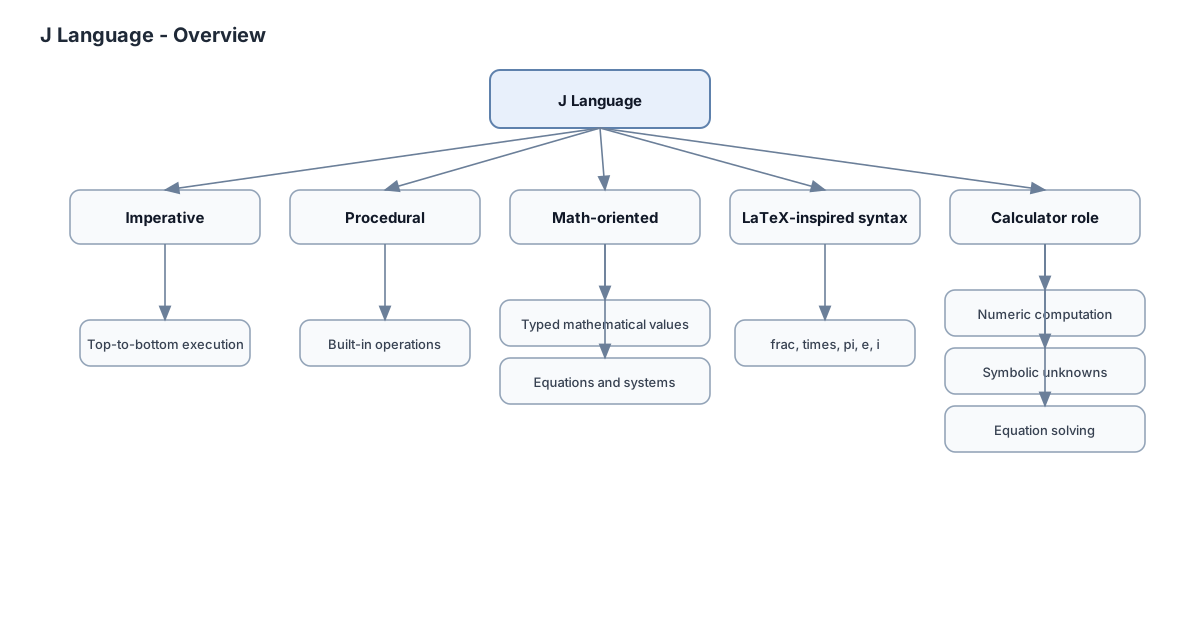
J is an imperative, procedural, expression-oriented language for mathematical computation and equation solving. The core design choice is replacing conventional notation with LaTeX-inspired syntax where practical.
Primary goals:
- Explicitly typed mathematical values
- Arithmetic expression evaluation
- Exact rational representation
- Real and complex number support
- Unknown variables and equation systems
- Constrained symbolic-style solving
Version 0.1 prioritizes semantic clarity and implementability in C.
2. General Language Model
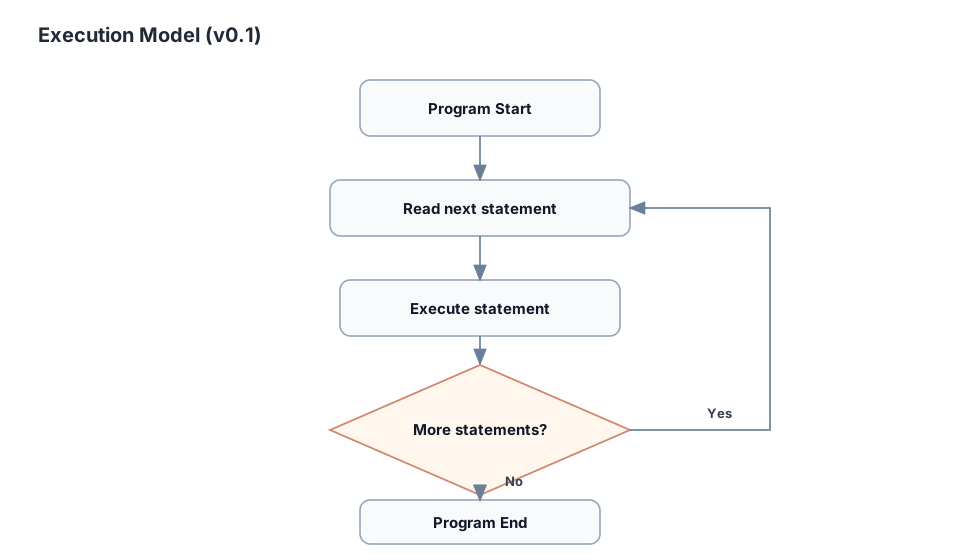
2.1 Execution Model
A J program is a top-to-bottom sequence of statements.
Statements may:
- Declare variables
- Assign values
- Declare equation systems
- Call built-ins
- Print values
- Request input
Out of scope in v0.1:
- User-defined functions
- Control flow (
if,while,for) - Arrays or containers
- User-defined types
- Modules/imports
3. Source Format and Lexical Conventions
3.1 Character Encoding
Source files are UTF-8. Syntax is ASCII-only in v0.1:
- Identifiers: ASCII letters/digits/underscore
- Keywords: ASCII
- LaTeX-style commands: ASCII sequences beginning with
\
3.2 Whitespace
Whitespace characters: space, tab, newline, carriage return. Whitespace is insignificant except for token separation.
3.3 Comments
// single-line comment
/* multi-line comment */
Multi-line comments do not nest in v0.1.
4. Identifiers and Reserved Words
4.1 Identifiers
identifier ::= [A-Za-z_][A-Za-z0-9_]*Valid:
x
value
_result
bad1
convert_to_reel
system_A
Invalid:
1x
my-value
\alpha
Backslash-prefixed names are commands, not identifiers.
4.2 Reserved Keywords
nat int rat reel comp bool unknown system True False4.3 Reserved Built-in Names (v0.1)
printf scan evaluate type is_equal
to_nat to_int to_rat to_reel to_comp
to_rect to_polar to_exp rat_to_frac
5. Type System
| Keyword | Mathematical Meaning | Description |
|---|---|---|
nat | Natural integers, with | |
int | Signed integers | |
rat | Rational numbers | |
reel | Real numbers | |
comp | Complex numbers | |
bool | Boolean values | |
unknown | - | Unsolved symbolic variable |
system | - | Named system of equations |
Numeric hierarchy:
nat ⊂ int ⊂ rat ⊂ reel ⊂ comp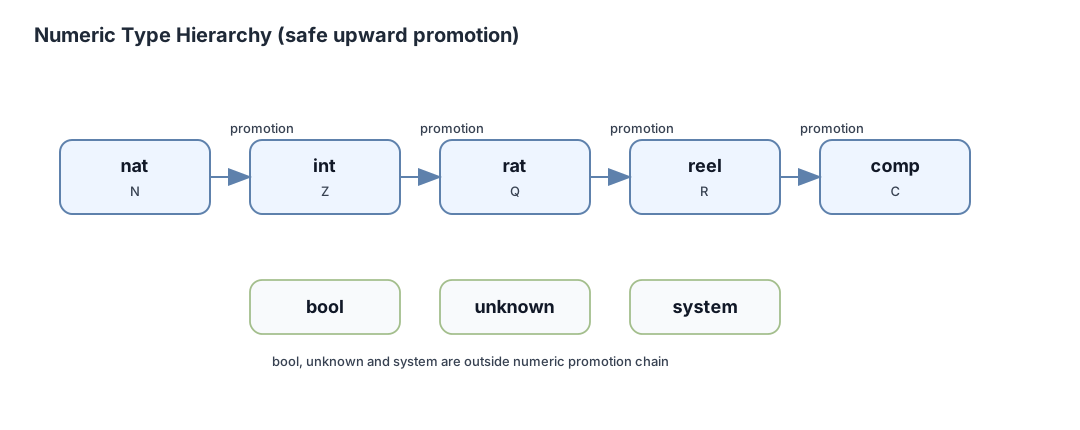
Implicit promotion is upward only.
Examples:
nat a = 0;            // valid
nat c = -1;           // error
int f = 1.5;          // error
rat g = \frac{2}{3};  // valid
reel h = \pi;         // valid
comp z = 4.12;        // valid (promoted to 4.12 + 0\i)
bool is separate from numeric types and has only True, False.
6. Literals and Mathematical Constants
6.1 Integer Literals
int_literal ::= [0-9]+A sign is not part of the literal; -4 is unary minus applied to 4.
6.2 Decimal Literals
dec_literal ::= [0-9]+\.[0-9]+Invalid in v0.1: .5, 5., 1e3.
6.3 String Literals
Strings are only allowed in eligible built-ins (not assignable variables in v0.1).
Supported escapes: \\, \", \n.
6.4 Built-in Constants
| Syntax | Meaning |
|---|---|
\pi | Constant pi |
\e | Constant e |
\i | Imaginary unit |
7. Supported LaTeX-Style Commands (v0.1)
| Command | Meaning |
|---|---|
\frac | Fraction constructor |
\times | Multiplication operator |
\pi | Constant pi |
\e | Constant e |
\i | Imaginary unit |
\sin | Sine |
\cos | Cosine |
\sqrt | Square root |
Any unknown backslash command is a lexical error.
8. Expressions
8.1 Arithmetic Operators
| Operator | Meaning |
|---|---|
+ | Addition |
- | Subtraction / unary negation |
\times | Multiplication |
^ | Exponentiation |
* and / are forbidden in J source.
Division is written as:
\frac{a}{b}8.2 Implicit Multiplication
Not supported in normal arithmetic expressions in v0.1.
Valid:
4 + 5 \times \i
10 \times (\cos(\frac{\pi}{2}) + \i \times \sin(\frac{\pi}{2}))
2 \times x
Invalid:
5\i
10(...)
2x
8.3 Precedence and Associativity
From highest to lowest:
- Parenthesized expressions, constants, literals, identifiers, function calls,
\frac{...}{...} - Exponentiation
^ - Unary minus
- Multiplication
\times - Addition/subtraction
+,- - Equality
=, only in equation contexts
Rules:
- Exponentiation is right-associative
- Multiplication is left-associative
- Addition/subtraction are left-associative
- Equality is non-associative
9. Statements
Every statement ends with ;.
int a = 3;
printf("x = %z\n", a);
Variable declaration:
type name = value;
type name1 = value1, name2 = value2;
Assignment:
a = 4;
z = 2 + 3 \times \i;
Unknown declaration:
unknown x;
evaluate(x + 2 = 5);
type(x); // int
10. System Declarations
system s : x, y {
    x = 1;
    y = x + 2;
}
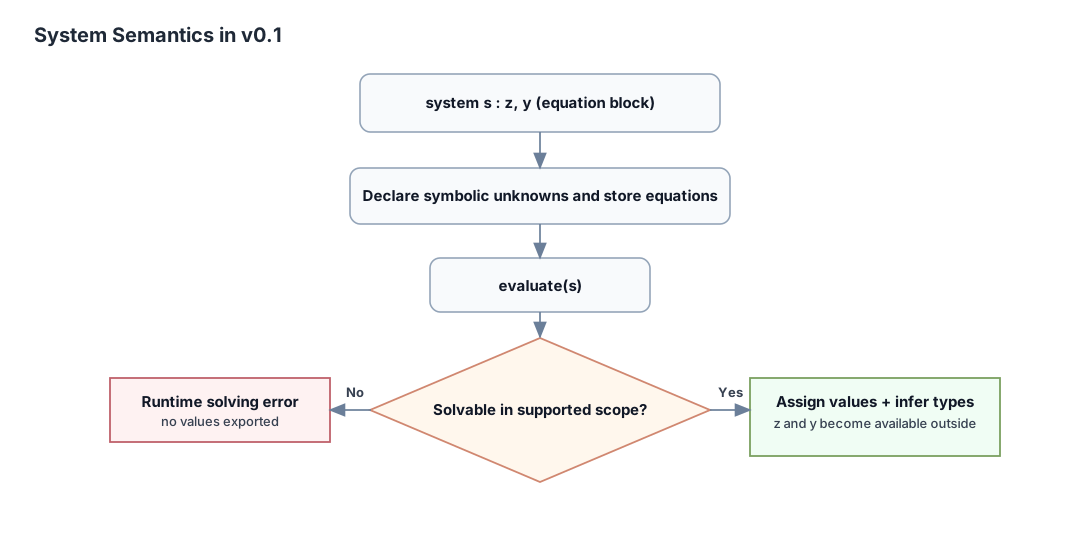
Rules (v0.1):
- Names after
:define unknowns in the system - Inside the block, only equation statements are allowed
- No nested systems
- Unknown names are local to the system until
evaluate(s)succeeds
11. Built-in Functions
11.1 Type Conversion
| Function | Description |
|---|---|
to_nat(x) | Convert to natural if possible |
to_int(x) | Convert to integer by nearest rounding |
to_rat(x) | Convert to rational form |
to_reel(x) | Convert to real part (lossy on complex) |
to_comp(x) | Promote to complex |
Examples:
int a = to_int(\pi);
reel b = to_reel(4 + 5 \times \i);
comp c = to_comp(3);
rat d = to_rat(0.5);
11.2 Complex Form Conversion
to_rect(z), to_polar(z), to_exp(z) return representation forms.
11.3 Rational Representation
rat_to_frac(2.5); // \frac{5}{2}11.4 Type Inspection
type(x)11.5 Equality Test
is_equal(a, b)11.6 Equation Evaluation
evaluate(...) solves equations/systems with constrained v0.1 scope:
- Single-variable linear equations
- Single-variable quadratic equations (within supported numeric domain)
- Simple linear systems of two variables
Examples:
unknown x;
evaluate(x + 2 = 5);

unknown y;
evaluate(y^2 - 1 = 0);

system s : x, y {
    x + y = 10;
    x - y = 4;
}
evaluate(s);
12. Input and Output
12.1 printf
printf("format", arg1, arg2, ...);Type specifiers:
| Specifier | Required Type |
|---|---|
%b | bool |
%n | nat |
%z | int |
%q | rat |
%r | reel |
%c | comp |
%u | unknown |
%s | system |
12.2 scan
int a = scan();
int b = scan("Enter an integer: ");
In v0.1, scan appears only in initializing declarations.
13. Error Categories
- Lexical: unknown command, bad character, unterminated string/comment
- Parse: malformed statement/structure, missing delimiters
- Type: incompatible assignments/calls, unsolved
unknownmisuse - Runtime: division by zero, unsupported equation form, failed conversion/solve
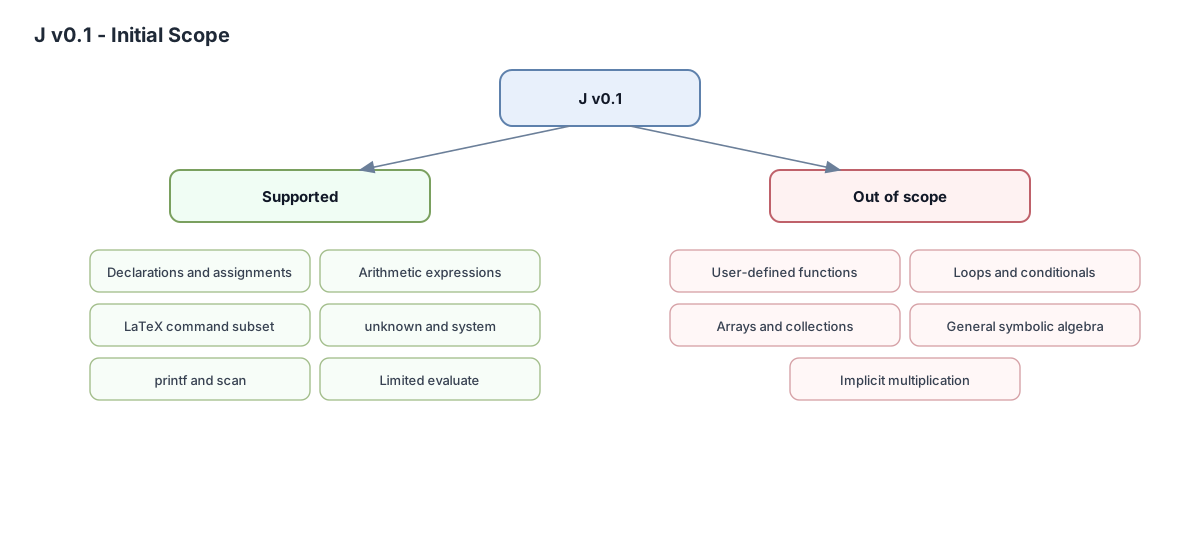
14. Initial Implementation Scope (v0.1)
Supported:
- Declarations and assignments
- Numeric/symbolic built-in types
- Arithmetic expressions and listed LaTeX-style commands
unknown,system, built-insprintf,scan- Constrained
evaluate
Explicitly out of scope:
- User-defined functions
- Loops/conditionals
- Arrays/collections
- String variables as first-class values
- General implicit multiplication
- General symbolic algebra beyond constrained
evaluate
15. Examples
reel a = 1.25;
reel b = 2.5;
printf("a + b = %r\n", a + b);
nat a = 2;
int b = -4;
rat c = \frac{2}{3};
reel d = \pi;
comp e = 4 + 5 \times \i;
bool h = True;nat bad1 = -1; // error
int bad2 = 1.5; // error
comp ok = 4.12; // validunknown x;
evaluate(x + 2 = 5);
type(x);system s : z, y {
z = 21 + y;
z = 12;
}
evaluate(s);
type(z);
type(y);16. Summary of Design Decisions
| Topic | Decision |
|---|---|
| Language style | Imperative, procedural, math-oriented |
| Semicolons | Mandatory |
| Character set | UTF-8 source, ASCII syntax in v0.1 |
| Multiplication | \times only |
| Division | \frac{...}{...} only |
* and / | Forbidden |
| Implicit multiplication | Not supported in normal expressions (v0.1) |
| Conversions | Pure functions returning converted values |
= | Assignment in statements, equality in equation contexts |
evaluate scope | Constrained to simple equations/systems |